Gallery Sculpture Commission: How the Process Works
A gallery sculpture commission is a made-to-brief artwork, agreed in stages: consultation, concept, approved design, a written contract, fabrication, then installation. Private commissions can move quickly. Public and institutional ones add committees, drawings and formal reviews. Either way, the best results come from a clear brief, a written agreement and an early conversation about how the piece will be installed and lit.
This guide walks through each stage the way we run it at FLY Miami Art, where we build handcrafted pop art sculptures with UV-reactive materials that glow under blacklight. It is written for collectors, gallery owners, designers, developers and city staff who are about to commission something for the first time.
TL;DR
- Commissions follow a sequence: consultation, concept, design approval, contract, fabrication, delivery and installation. Each stage should end in a sign-off.
- Public commissions are generally more complicated than private ones, with committees, requests for proposals and multi-stage reviews.
- A written agreement should cover scope, schedule, payment milestones, insurance, transport, ownership, copyright, maintenance and termination.
- Budget and timeline depend on size, materials, site conditions and approvals. A studio that quotes a flat number before seeing your brief is guessing.
- For immersive or glow work, settle lighting, power and access early, because they shape both the design and the installation.
Table of Contents
- What a sculpture commission actually is
- The process, step by step
- Writing the brief
- How concept and final design get approved
- What the contract should cover
- Budget: what moves the number
- How long it takes
- Indoor, outdoor and immersive considerations
- Our perspective
- Work with us on your commission
- FAQ
- Sources
What a sculpture commission actually is
When you buy from a gallery wall or an online collection, the piece already exists. When you commission, the artist makes something for you, your space or your institution. You agree on subject, scale, materials, finish and installation before fabrication begins.
You can commission in two ways. Through a gallery, the gallery usually acts as the go-between: it presents artists, handles contracts and often manages delivery. Directly with the artist, you talk to the maker from the first call, which tends to shorten feedback loops and keeps the concept close to the artist’s voice. Both routes use the same underlying steps. The difference is who holds the conversation.
If you want to see what a direct studio relationship looks like, our commissions page is the starting point, and our sculpture collection shows the kind of work we make.
The process, step by step
The National Sculpture Society, which publishes guidance for people commissioning work, notes that public commissions are generally more complicated than private ones. It describes one public process built around a committee, a request for proposals, proposal review, finalist maquettes and a contract (National Sculpture Society). A private commission compresses that into fewer steps, but the logic is the same.

1. Initial consultation
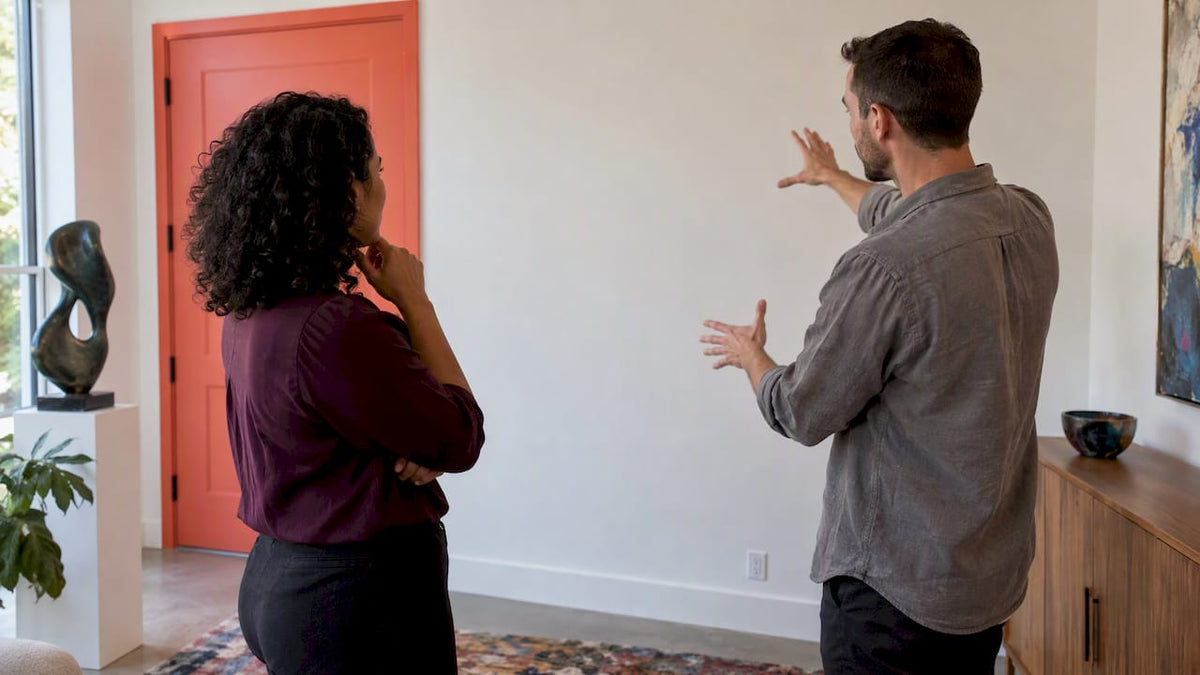
This is a conversation, not a sales pitch. You share where the piece will live, who will see it, what mood you want and a rough budget range. The artist tells you what is realistic in the materials and timeframe. Bring photos of the space, rough dimensions and any pieces you admire.
2. Concept development
The artist responds with sketches, reference images or a mood board. At this stage you are judging direction, not details. Does the idea feel right for the room, the audience and the message you want to send?
3. Design and approval
The concept becomes a defined design: dimensions, materials, color, base, mounting and how the piece sits in the site. For larger works, a scaled maquette or rendering lets everyone approve what they will actually get. This is the stage where changes are cheap. After fabrication starts, they are not.
4. Proposal and contract
The studio issues a written proposal with price, schedule and payment milestones. Once you accept it, a contract formalizes it. See the contract section below, and our guide to what to put in writing in an art commission contract.
5. Fabrication
The artist builds the piece. Good studios share progress photos at agreed checkpoints so there are no surprises. Any change requested now should be priced and approved in writing.
6. Delivery and installation
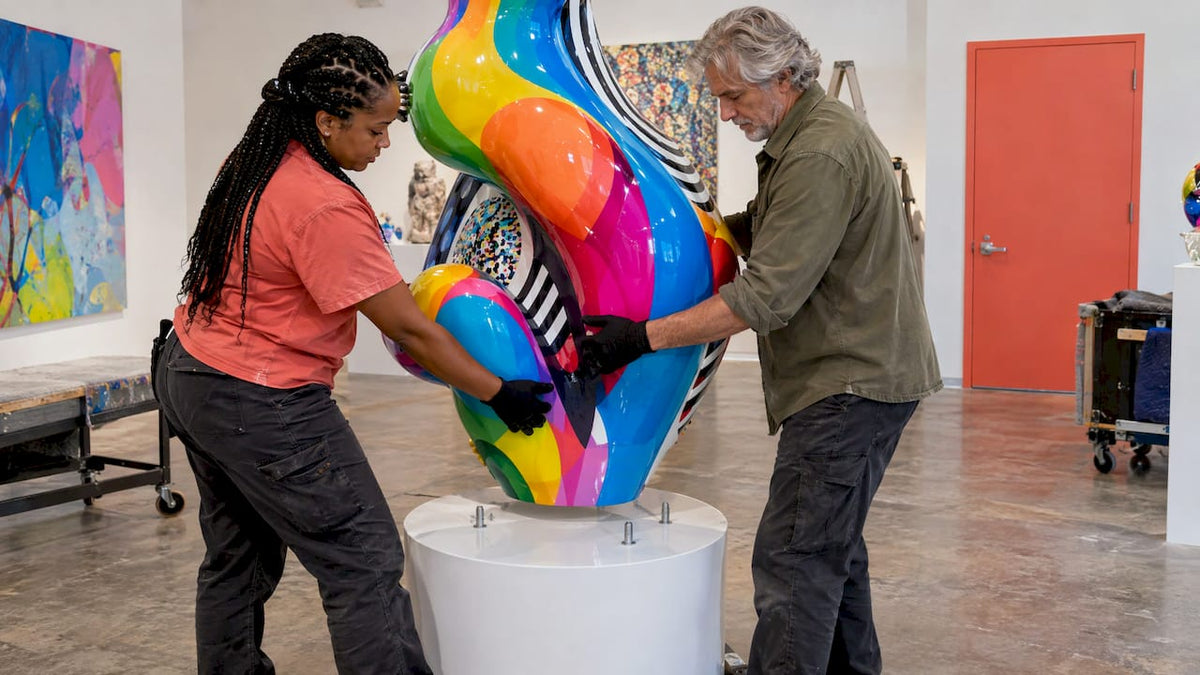
Crating, transport, site access, mounting hardware, lighting and cleanup all belong in the plan from the start. For larger or multi-part work, see our notes on modular sculpture installation and how to display large scale art installations.
Writing the brief
A strong brief saves weeks. It does not need to be long, but it should answer these questions:
- Site: indoor or outdoor, the room or location, ceiling height, floor loading, and who has access.
- Audience: a private home, gallery visitors, hotel guests or the general public.
- Intent: the mood, theme or message. For our work, that is often peace, unity, play and celebration.
- Scale: approximate height, width, depth and weight limits, plus how it will move through doors and elevators.
- Budget range: a range lets the artist propose the right materials rather than guess.
- Timeline: the date you need the piece by and any event it must be ready for.
- Decision makers: who signs off, and how many people need to agree.
Institutions ask for more. Philadelphia’s Art Commission, for example, says a proposal cover letter should describe the artwork, the selection process, the construction project and the installation site, and name the donor, sponsoring department and maintenance parties. Submissions also include photographs, renderings and supporting materials (City of Philadelphia). Even if your commission is private, borrowing that checklist makes your brief clearer.
How concept and final design get approved
Approval is rarely a single yes. Many bodies review in stages, and understanding the stages helps you plan your calendar.
- Philadelphia typically reviews in two stages: a concept review of the idea and siting, then a final review of all design and installation aspects that incorporates the earlier comments (City of Philadelphia).
- The U.S. General Services Administration requires a preliminary concept that communicates the artistic expression, scope, design, location, size, materials, color, texture and relationship to the building, using drawings, models, photographs, renderings or animations, and a narrative. Approval by the regional chief architect and the Center for Fine Arts authorizes development of the final concept (GSA Art in Architecture Policies and Procedures, 2022). The final concept then describes proposed materials, preliminary fabrication and installation techniques, maintenance requirements and an itemized budget.
- Cornell University’s outdoor art committee asks for an artist biography, an artistic-intent narrative, site context, multiple views, dimensions, weight and volume, ownership or loan terms, purchase and lifecycle costs, funding sources and target installation dates. The committee can support a proposal as presented, support it with conditions, decline, or ask for more information, and once a complete proposal is accepted it has up to 30 days to act (Cornell Facilities and Campus Services).
The practical lesson: build review time into your schedule, and ask the artist to prepare materials in the format your reviewers expect. Our article on what makes public sculpture development-ready covers how we package a piece for that process.
What the contract should cover
A handshake and an email thread are not enough for a custom work. The National Sculpture Society’s guidance says a written agreement should cover the scope of the commission, timeline and milestones, payment terms, responsibilities, insurance, transport and installation, ownership, copyright, maintenance and termination (National Sculpture Society).
In plain terms, that means answering these before anyone picks up a tool:
| Topic | Question to settle in writing |
|---|---|
| Scope | What exactly is being made, at what size, in which materials? |
| Schedule | What are the milestones, and what happens if one slips? |
| Payment | What is due at signing, at design approval and at delivery? |
| Revisions | How many design rounds are included, and how are extra changes priced? |
| Insurance and transport | Who insures the work in the studio, in transit and on site? |
| Ownership and copyright | Who owns the object, and what reproduction rights does the artist keep? |
| Maintenance | Who cleans, repairs and inspects the piece, and how often? |
| Termination | What happens to payments and work in progress if either side ends the deal? |
Developers and larger clients face extra layers, such as multiple stakeholders and approvals. Our guide to art commission agreements for developers goes through those.
Budget: what moves the number
We do not publish a fixed price for commissions, because the price depends on the brief. These are the factors that move it most:
- Size and weight. More material, more labor and more complex transport.
- Materials and finish. Handcrafted surfaces, specialty pigments and protective coatings all change cost. UV-reactive work adds a layer of finishing and testing under blacklight.
- Site conditions. Outdoor placement needs weather resistance. Cornell’s committee, for instance, weighs environmental durability and lifecycle cost alongside scale, ownership, transportation and installation costs, maintenance responsibility, and risks such as climbing or vandalism (Cornell).
- Installation. Lifts, anchoring, power, lighting and labor can be a real share of the total. We wrote about how to reduce sculpture installation costs for UV art.
- Approvals and documentation. Renderings, itemized budgets and revisions for review boards take studio time.
The most useful move you can make is to give the artist a budget range at the first meeting. That lets the artist design to the money instead of discovering a mismatch after three rounds of sketches.
How long it takes
Timelines vary with scope, so ask for a milestone schedule in the proposal rather than a single delivery date. In general, a private piece moves faster, since you approve the design yourself. Public work waits on committee cycles, which is why the Cornell example above builds a 30-day action window into its process, and why a two-stage review such as Philadelphia’s should be counted into your calendar before fabrication is scheduled.
To keep a schedule honest, work backward from the unveiling or opening. Allow time for design approval, fabrication, curing or finishing, shipping and a day or more of on-site installation. If an event is fixed, tell the artist at the first meeting.
Indoor, outdoor and immersive considerations
Where a sculpture lives changes how it should be built.
Indoor and gallery settings. Consider floor loading, sightlines, and how people move around the piece. Our piece on what makes a sculpture exhibition engaging looks at spacing, lighting and visitor flow. Collectors who care about quality can also borrow the habit of separating museum-grade versus everyday pieces when planning a temporary display: show the best work with the best lighting, and keep it protected.
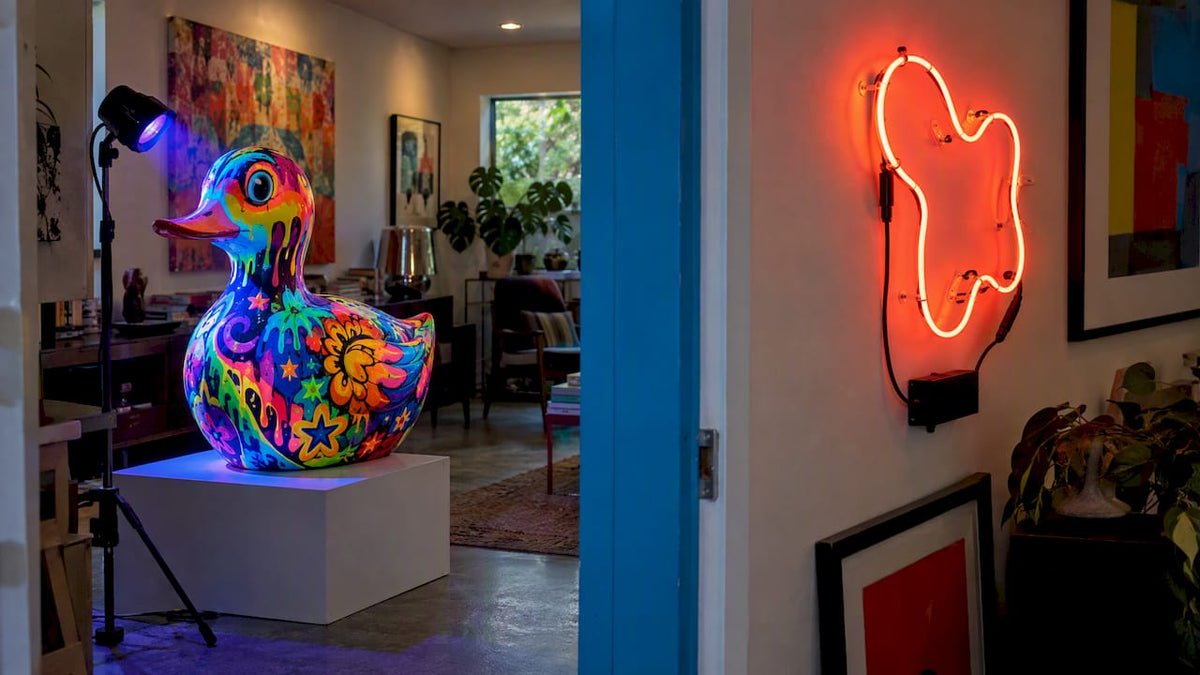
Glow and blacklight work. UV-reactive pigments reveal hidden patterns and colors only when the right light hits them. That means planning a dimmable or controllable lighting zone, power for UV fixtures, and a viewing angle where the effect lands. Decide early whether the piece should also look good in ordinary light, because most rooms will have both.

Outdoor and public settings. Weather, sun exposure, vandalism and maintenance all matter. See our four contract terms for weatherproof glow art and our notes on site-specific sculpture and UV materials.
Accessibility. San Diego’s temporary exhibit toolkit says exhibits on City property or in the public right-of-way must be visually and physically accessible, must not interfere with access for people with disabilities under ADAAG, and should provide safe, accessible paths of travel (City of San Diego). Dim lighting for glow work makes this especially important, so plan pathways, edge protection and signage. Our ADA accessibility guide for public sculptures goes deeper. Always confirm the rules with the local authority that governs your site.
Our perspective
Most commissions go wrong at the same point: the client and the artist think they agreed on something, but nobody wrote it down. We start with the feeling you want people to have when they walk up to the piece, then work backward to size, materials and light.
Everything we make is handmade and original, never mass produced. Our UV-reactive pigments are chosen so the work holds its own in daylight and then reveals a second layer under blacklight. That reveal is the point: it turns a sculpture into an experience, and for us that experience is tied to peace and unity.
We prefer to show you maquettes, renderings and finish samples before we build anything full size. It costs a little more time at the start and saves a lot of it later. If your site needs approvals, we prepare the drawings and narrative your reviewers expect, so the committee sees a finished idea rather than a rough one.
Facundo
Work with us on your commission
We take commissions from private collectors, galleries, hotels, brands, developers and public institutions. Each one starts with a conversation about your space and your story. If you want a glowing rubber duck piece or a custom glow sculpture, start with our custom glow piece page, or contact us through our commissions page.
Would you rather see finished work first? Browse the UV/Glow Art collection, the originals or our past works to get a feel for scale, color and finish.
FAQ
Should I commission through a gallery or directly from the artist?
Both work. A gallery can manage contracts, shipping and introductions, which helps if you are new to commissioning. Going direct gives you a closer conversation with the maker and usually fewer steps between your feedback and the work. Either way, insist on the same written agreement terms.
How do I know what a commission will cost?
Ask for a written proposal after the design is defined. Cost depends on size, materials, site conditions, installation and approvals, so a number given before the studio has seen your brief is only a guess. Sharing your budget range early lets the artist design to it.
Can a commissioned sculpture be made to glow under blacklight?
Yes, that is our specialty. We build UV-reactive pigments into the work so it reveals hidden patterns and colors under blacklight. You will want to plan lighting and power for the space, and we can advise on that during the design stage.
What approvals do public sculptures need?
It depends on the owner of the site. Cities, universities and federal agencies each have their own review stages, and many ask for renderings, dimensions, materials, maintenance plans and budgets. Check with the local arts commission or facilities office before you finalize the design.
Sources
- Commissioning a Work of Sculpture, National Sculpture Society
- Apply for artwork approval from the Art Commission, City of Philadelphia
- Art in Architecture Policies and Procedures, U.S. General Services Administration
- FAQ for Preparing a Public Art Proposal, Cornell University
- Temporary Exhibit Toolkit, City of San Diego
- Museum-grade versus everyday specimens