Brand Activations With Art: How to Plan One That Works
A brand activation with art works when guests do something with the artwork, not just walk past it. The strongest ones combine an original, memorable object or environment with a clear audience goal and a way to measure what people did. A commissioned, handmade piece that glows, reveals hidden detail and invites photos gives you the first part. Your brief and your metrics supply the rest.
This guide is for brand teams, hotel and venue owners, gallery operators, developers and city staff who are considering art as the center of an activation. It covers the difference between an activation and a display, the formats available, a planning sequence, real U.S. examples and how to measure results.
TL;DR
- An activation asks people to take part. A logo beside a sculpture is exposure, not activation.
- Start from one specific audience and one measurable goal, then choose the art format that fits the venue.
- Art that changes under different light, or rewards a second look, gives guests a reason to stay and share.
- Build in durability, walking routes and staffing from the start, especially for crowds or public sites.
- Measure in three layers: reach, engagement quality and business outcomes.
Table of Contents
- What makes art an activation and not a decoration
- Formats that get guests to participate
- Examples from U.S. activations
- Planning an art-led activation, step by step
- Know when the brand should step back
- How to measure an art activation
- Our perspective
- Commission a piece for your activation
- FAQ
- Sources
What makes art an activation and not a decoration
A brand activation is an interactive exchange between a brand and its audience. One 2026 guide puts the line plainly: a logo on a lanyard is exposure, while giving people a place to co-create art is activation. The first asks for attention. The second asks for involvement.
Art adds a second distinction. An artist starts with an idea, a brand starts with an audience it wants to reach, and when the brand message crowds out the artist’s voice, visitors notice quickly. The best briefs protect both: the artist keeps a real point of view, and the brand gets a reason for people to come, stay and talk.
That is why original work beats generic decor in this setting. A mass-produced backdrop looks like every other backdrop. A handmade, one-of-a-kind piece gives guests something they have not photographed before.

Formats that get guests to participate
Participation does not have to mean handing everyone a paintbrush. There are four formats that work in practice.
Immersive installations
A room or structure that visitors move through, with layered detail, lighting and sound. The space should reward time: a layered environment gives people several reasons to stay, unlike a single photo wall.
UV-reactive art is a natural fit here. Our pieces use UV-reactive pigments, so under blacklight they glow and reveal hidden patterns and colors that are invisible in ordinary light. Guests discover the work in stages, which creates dwell time without a single instruction sign. For more on why this suits busy venues, see our guide on why UV art works in public spaces.
Co-created art
Visitors contribute to a collective piece. At the 2026 Aesthetic Next event, guest photos became a 5 ft by 10 ft mosaic of 1,026 images over three days, so attendees became contributors. The principle scales: every guest leaves a mark, and the finished work becomes the story.

Art that responds to movement
American Express’s US Open fan space included an installation that turned a tennis swing into shareable visual and auditory art, reaching more than 10,000 participants across the tournament. The art was the reward for taking part.
Sculptural landmarks and photo moments
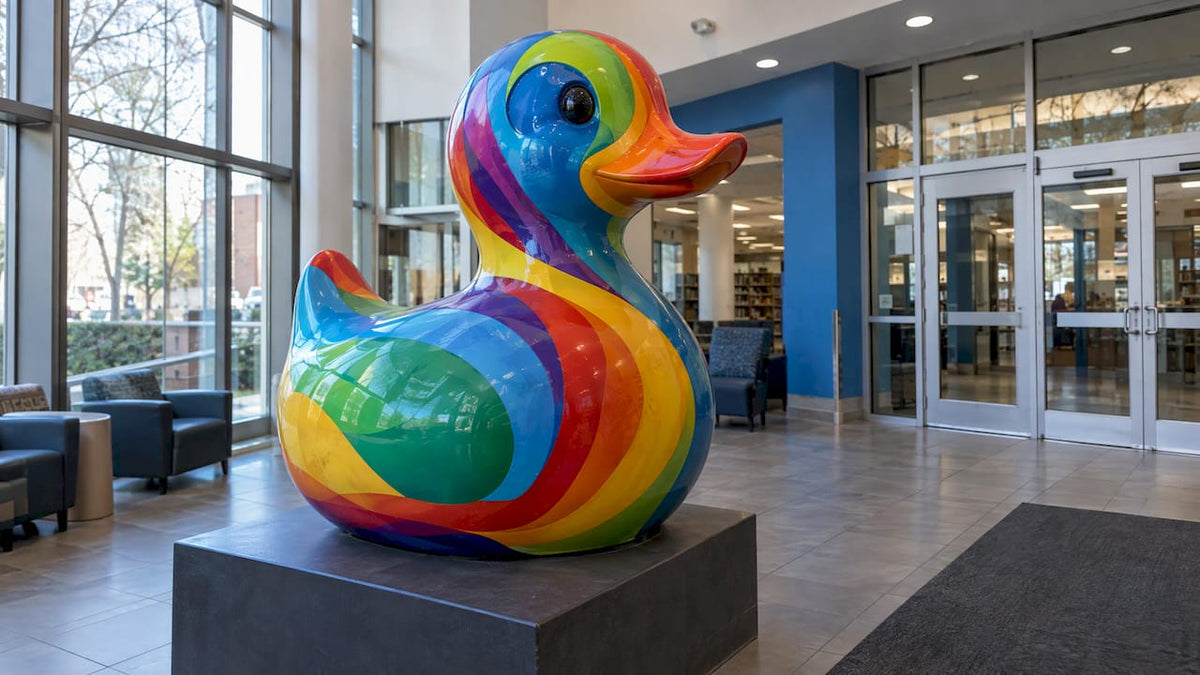
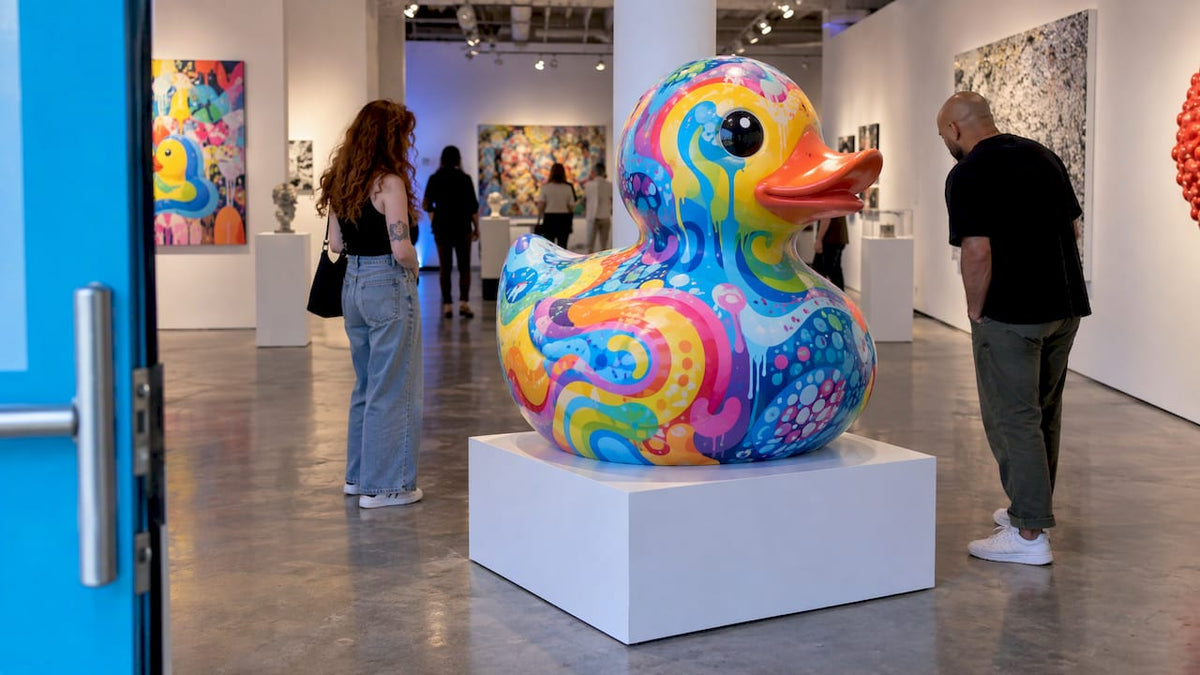
A single strong sculpture can anchor a lobby, pop-up or plaza. A pop art sculpture with a recognizable theme, such as our rubber duck series, gives guests a figure they want to stand next to. The key is that the piece is distinctive enough to be shared without a hashtag prompt. Our ten buildable brand art ideas go deeper on turning footfall into data.
Examples from U.S. activations
Four recent examples show different scales.
| Activation | What guests did | Reported result |
|---|---|---|
| American Express, US Open | Turned tennis swings into shareable art | 10,000+ participants |
| Visa, Super Bowl LX Sunday Experience 2026 | Made screen-printed artworks with an artist | 5,000+ unique prints, 95% positivity |
| Netflix, The Queen’s Gambit installation, Los Angeles | Walked a life-sized chess board, watched a youth exhibition match | 7,000 attendees |
| Fremont Park Bloom, Sacramento | Visited a public park installation | 58.5K visitors |
The common thread is not budget. Each gave guests something to do, make or discover, and each tied the art to a place or a story. The Sacramento project is the clearest model for city staff and developers: the installation period drew a 72% increase in visitors over the same span the year before, with 43.7K coming from outside the district and an average stay of 79 minutes.
If you are working on a civic site, our notes on interactive civic art installations and public art community engagement cover what lasts after the opening.
Planning an art-led activation, step by step
Most planning guides agree on the order. Define measurable objectives first, then the audience in demographic and behavioral detail, then the concept, then venue constraints, and settle measurement before building. Here is how that looks when art is the centerpiece.
1. Write one specific objective
“Build awareness” is too broad to design against. A better objective names who should change what: for example, moving consideration from neutral to positive among a defined group in a defined city. Everything downstream, from the artwork’s theme to its location, follows from that sentence.
The mistake to avoid: choosing the art you like before you know who it is for.
2. Describe the audience by behavior
A hotel guest, a festival crowd and a family at a downtown plaza behave differently. Do they linger or pass through? Do they photograph and post? Young families want pieces that are bright and approachable. Design-minded guests respond to craft and detail. Pride audiences respond to work that is clearly made with them in mind.
3. Turn the brand promise into a physical experience
The concept should express what the brand stands for through the artwork itself, not through signage. A brand about optimism might commission a glowing piece with a message of peace and unity. A hospitality brand might want a lobby sculpture that changes character after dark. We handle this through commissions: a custom glow piece, handmade and original, made for your space and theme. Our guide to immersive art for hotels shows how to brief one.
4. Treat the venue as the constraint
Before anything is built, check foot traffic, footprint, ceiling height, floor load, electrical access, loading routes, permits and lead times. An installation open to thousands of visitors needs durable materials, clear walking routes, guiding staff and permits for any public site. For blacklight work, also plan which areas can be dimmed. Our immersive exhibition design checklist and common planning mistakes are useful before you sign off on a layout.
5. Build in sharing and data capture
Decide in advance how a visit becomes data: a QR code at the entrance, a branded hashtag at the photo spot, a sign-up for a limited print. Place these where guests naturally pause, not where they block the walkway.
6. Staff it
Trained hosts who can explain the piece, point out hidden details and keep lines moving make a measurable difference to dwell time and mood.
7. Measure against the original objective
The next section covers this.
Know when the brand should step back
One point separates good activations from forgettable ones. A logo in the corner, a carefully placed product or a sponsor credit on a wall label is often enough. Heavy branding turns the work into an ad, and audiences respond to it as one.
This is also why the artist matters. A piece by an award-winning artist with public works and media coverage carries its own credibility. The brand is associated with it rather than forcing itself onto it.
How to measure an art activation
One widely used framework has three tiers. Tier one is reach and exposure (attendance, impressions, earned media value). Tier two is engagement quality (dwell time, participation rate, user-generated content volume, data captures). Tier three is business outcomes (sales lift, redemption, repeat purchase over 30, 60 and 90 days).
A practical way to use it with art:
- Reach: door counts, scans at the entrance, press and social mentions.
- Engagement: average stay time, how many guests interact with each element, photos posted with your tag. Understanding what authentic engagement looks like helps you separate real interest from inflated numbers.
- Outcomes: survey recall and intent before and after, then track purchases or bookings in the weeks that follow.
For social benchmarks, engagement rate benchmarks for campaigns give you a reference point for what counts as a strong response in your category.
Capture in-the-moment feedback where you can. Responses gathered on site reflect how guests actually felt, rather than what they remember a week later. The Sacramento case is a good model for public-sector reporting: it tracked total visitors, visitors from outside the district, estimated local economic impact and average stay against the previous year, so the result could be compared like for like.
Our perspective
We make pop art sculptures that change when the lights change. Under ordinary light you see the color and the character. Under blacklight, hidden patterns and colors appear, and people lean in. That moment of discovery is exactly what an activation is trying to create, and we build it into the object itself.
Every piece is handmade and original. Nothing is mass produced. For a brand, that matters: guests can feel the difference between a printed backdrop and something an artist made with his hands, and they photograph it differently.
The themes I return to are peace and unity. They suit public spaces, hotels, pride events and family settings because they invite everyone in. If the art is warm and a little surprising, the brand can stay modest and still be remembered.
My advice is to commission early. A piece made for your venue, audience and message will always outperform something chosen from a catalog at the last minute.
Facundo
Commission a piece for your activation
If you are planning an activation, hotel installation or public project, we can make a custom glow piece around your theme and space. Brands, hotels, galleries and public institutions commission work from us, and collectors can also browse originals, sculpture and UV/glow art for private or commercial settings.
Start with the custom glow piece page or explore commissions. To see what a finished piece looks like, browse our UV/glow art collection.
FAQ
What is the difference between a brand activation and an art exhibition?
An exhibition shows art to visitors. An activation gives a defined audience something to do with it, in service of a brand goal such as recall, trial or sign-ups. The two can overlap when the exhibition is designed with participation and measurement in mind. Our guide to participatory art in galleries explains the participation side.
How far ahead should I plan an art activation?
Set objectives and venue requirements first, since permits, load limits and electrical needs shape what can be built. A handmade commission needs time on top of that, so approach the artist as soon as your theme and site are known rather than after the layout is fixed.
Can a single sculpture be an activation?
Yes, if it gives people a reason to stop, interact and share. A distinctive sculpture with a hidden layer, such as UV-reactive detail, plus a simple capture mechanism like a QR code and a staffed host, can meet the definition. Layered pieces work better than flat photo walls because they reward time.
What should I measure first?
Pick the metric tied to your original objective. For awareness, that is recall measured before and after. For engagement, it is dwell time and participation rate. For sales, it is redemption and purchases over the following 30 to 90 days.
Sources
- 19 Brand Activation Ideas and Examples for Events
- When an Art Installation Doubles as a Brand Activation
- American Express: US Open Fan Experience
- Aesthetic Next 7.0 Brandsaic Event
- The Visa Print Shop: Super Bowl LX Sunday Experience 2026
- The Queen’s Gambit FYC Installation
- Case Study: Fremont Park Bloom
- Brand Activation Planning: Step-by-Step Guide for 2026
- Brand Activation Strategy: What Works, What Doesn’t, and Why
- What Is Authentic Music Engagement
- Engagement Rate Benchmarks for Influencer Campaigns in 2026